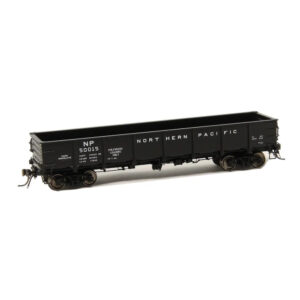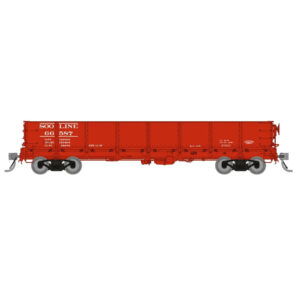

40' Drop Bottom Gondola
Prototype Information
Railroads introduced the 40-foot drop-bottom gondola in the late 19th and early 20th centuries to solve a major labor bottleneck. Early gondolas required workers to shovel bulk cargo by hand. Car builders fixed this by installing hinged floor doors connected to chains, shafts, and winding levers. A brakeman simply tripped the lever, and the load dumped directly through the floor onto pit tracks or elevated trestles. By the 1920s, railroads standardized on 40-foot composite and all-steel designs for heavy-duty hauling.
These 40-foot “General Service” cars delivered unmatched versatility across the steam and early diesel eras. Crews dumped coal, ore, sand, and ballast through the floor doors. With the doors pinned flat, the exact same car hauled steel plates, lumber, and machinery. Major lines like the Southern Pacific, Union Pacific, Northern Pacific, and Denver & Rio Grande Western operated thousands of them. By the 1950s, specialized high-capacity hoppers and rotary dumpers rendered the complex door mechanisms obsolete. Railroads eventually welded the doors shut, moved the surviving cars to maintenance-of-way service, or scrapped them altogether.
Products
Showing all 7 results
-
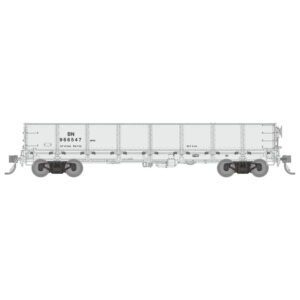
Rapido HO 40′ Drop Bottom Gondola Burlington Northern “Maintenance of Way”
$49.00 Select options This product has multiple variants. The options may be chosen on the product page -

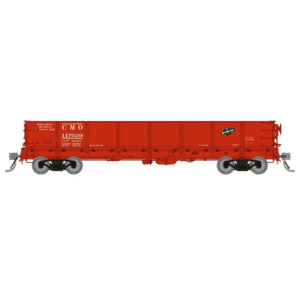
Rapido HO 40′ Drop Bottom Gondola Chicago & North Western “CMO”
$49.00 Select options This product has multiple variants. The options may be chosen on the product page -
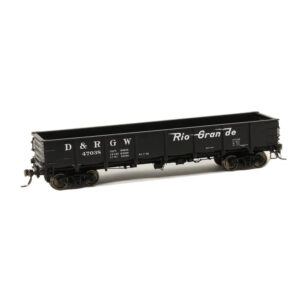
Rapido HO 40′ Drop Bottom Gondola Denver & Rio Grande
$49.00 Select options This product has multiple variants. The options may be chosen on the product page -
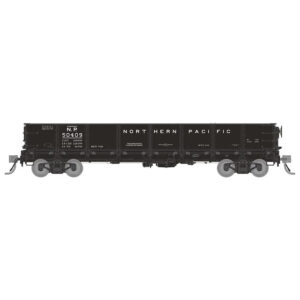
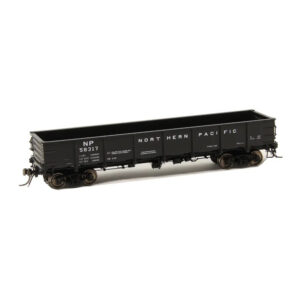
Rapido HO 40′ Drop Bottom Gondola Northern Pacific “1940 Scheme”
$49.00 Select options This product has multiple variants. The options may be chosen on the product page -
Rapido HO 40′ Drop Bottom Gondola Northern Pacific “1966 Scheme”
$49.00 Select options This product has multiple variants. The options may be chosen on the product page -
Rapido HO 40′ Drop Bottom Gondola Northern Pacific “Pulpwood Service”
$49.00 Select options This product has multiple variants. The options may be chosen on the product page -
Rapido HO 40′ Drop Bottom Gondola Soo Line
$49.00 Select options This product has multiple variants. The options may be chosen on the product page