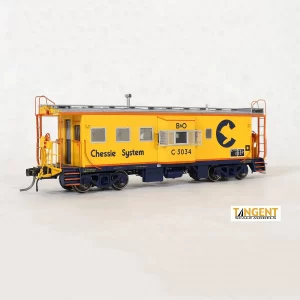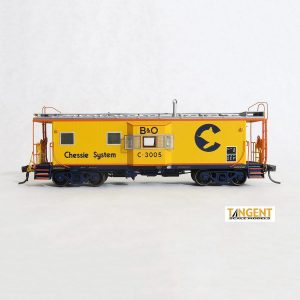

B&O ICC I-18 Steel Bay Window Caboose
Prototype Information
The Baltimore & Ohio (B&O) hired the International Car Company in 1965 to modernize its caboose fleet. This new order replaced aging wooden cars and older home-built steel models. The B&O chose the bay window design to increase crew safety. Side windows removed the danger of crew members falling from high cupola seats during sudden stops. These windows also allowed the crew to see past the taller freight cars used in modern service.
The first major group of these cars entered service as the I-17 class. They featured rugged steel bodies, cushioned underframes, and modern interior workspaces. The builder used an “offset” window design, placing the bay closer to one end of the car. In the 1970s, the railroad added the I-17A class. These cars looked the same but included improved electrical and braking systems.
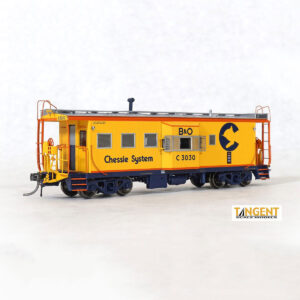
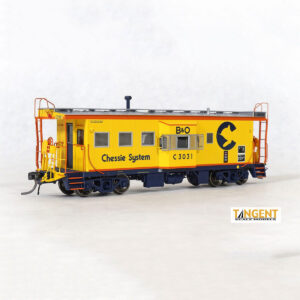
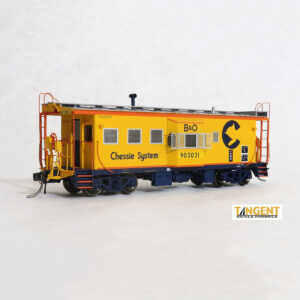
In the 1970s, the B&O became part of the Chessie System. These cabooses then received the famous yellow, orange, and blue paint scheme with the “Ches-C” kitten logo. Their strong steel frames handled the heavy forces of coal trains in the Appalachian Mountains. CSX eventually replaced these cars with electronic devices in the 1980s. However, many B&O survivors still help crews today during long backup moves in local freight yards.
Showing all 7 results
-
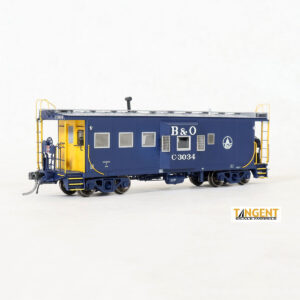
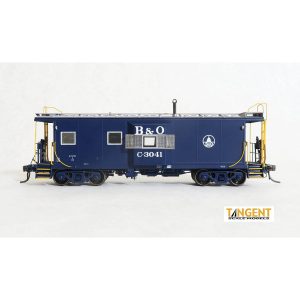
Tangent HO ICC I-18 Steel Bay Window Caboose Baltimore & Ohio “1965+” w/ Lights
$102.00 Select options This product has multiple variants. The options may be chosen on the product page -

Tangent HO ICC I-18 Steel Bay Window Caboose Baltimore & Ohio “1968+” w/ Lights
$102.00 Select options This product has multiple variants. The options may be chosen on the product page -
Tangent HO ICC I-18 Steel Bay Window Caboose Chessie System “B&O 1973+ Dubois Repaint” w/ Lights
$102.00 Select options This product has multiple variants. The options may be chosen on the product page -
Tangent HO ICC I-18 Steel Bay Window Caboose Chessie System “B&O 1979+” w/ Lights
$102.00 Select options This product has multiple variants. The options may be chosen on the product page -
Tangent HO ICC I-18 Steel Bay Window Caboose Chessie System “B&O 1982+” w/ Lights
$102.00 Select options This product has multiple variants. The options may be chosen on the product page -
Tangent HO ICC I-18 Steel Bay Window Caboose Chessie System B&O “Raceland Repaint 1979+” w/ Lights
$102.00 Select options This product has multiple variants. The options may be chosen on the product page -
Tangent HO ICC I-18 Steel Bay Window Caboose Chessie System B&O “Raceland Repaint 1981+” w/ Lights
$102.00 Select options This product has multiple variants. The options may be chosen on the product page