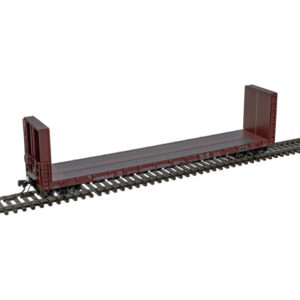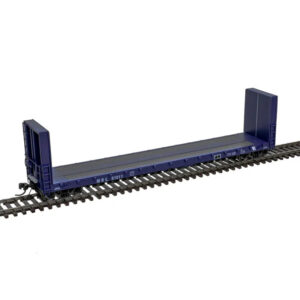

51'6" Bulkhead Flat Car
Prototype Information
In the late 1960s, Canadian railroads needed a better way to move timber. Workers previously struggled to secure lumber on standard flat cars or inside cramped boxcars. Manufacturers like National Steel Car and Marine Industries Ltd solved this with the 51′ 6″ bulkhead flat car. They added massive steel walls, called bulkheads, to each end of a rugged 51′ 6″ platform. These walls physically blocked the cargo from sliding during sudden stops. This design made loading faster and much safer for crews on the Canadian National and Canadian Pacific lines.
As the lumber industry shifted to larger cars in the 1980s, these flat cars took on new roles. Their heavy “fish-belly” frames and 70-ton trucks handled dense, industrial loads with ease. Railroads repurposed them to carry steel pipes, rebar, and aluminum ingots across the continent. Many of these cars still run today on regional short-line tracks. Their long life proves that simple, heavy-duty engineering can outlast decades of changing industrial needs.
Showing all 7 results
-

Atlas HO 51′ 6″ Bulkhead Flat Car Algoma Central “ex BCOL”
$38.00 Select options This product has multiple variants. The options may be chosen on the product page -

Atlas HO 51′ 6″ Bulkhead Flat Car British Columbia Railway
$38.00 Select options This product has multiple variants. The options may be chosen on the product page -
Atlas HO 51′ 6″ Bulkhead Flat Car Canadian National
$38.00 Select options This product has multiple variants. The options may be chosen on the product page -
Atlas HO 51′ 6″ Bulkhead Flat Car Canadian National “Orange, International Service”
$38.00 Select options This product has multiple variants. The options may be chosen on the product page -
Atlas HO 51′ 6″ Bulkhead Flat Car Duluth Winnipeg & Pacific
$38.00 Select options This product has multiple variants. The options may be chosen on the product page -
Atlas HO 51′ 6″ Bulkhead Flat Car Montana Rail Link
$38.00 Select options This product has multiple variants. The options may be chosen on the product page -
Atlas HO 51′ 6″ Bulkhead Flat Car North American Car Leasing “NAFX”
$38.00 Select options This product has multiple variants. The options may be chosen on the product page