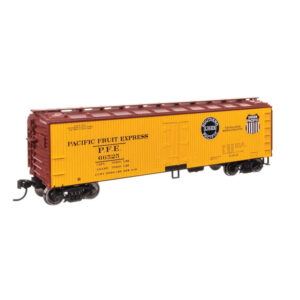

40' Wood Reefer
Prototype Information
The 40′ wood refrigerator car served as the backbone of perishable transport during the early 20th century. These cars relied on tongue-and-groove wood siding and thick layers of insulation, such as hairfelt or cork, to maintain internal temperatures. Ice bunkers located at each end of the car provided the cooling. Workers manually loaded blocks of ice through hatches on the roof. This technology allowed railroads to move fresh produce, dairy, and meat across vast distances. It transformed American diets by making seasonal goods available year-round in distant urban markets.
As train lengths and speeds increased, the original all-wood construction struggled with structural fatigue. The constant shifting of heavy ice loads often caused the wooden car ends to bow or break during switching. To solve this, railroads began a major transition to steel ends and steel underframes. These reinforced “composite” cars combined the insulating properties of wood sides with the rigidity of steel. Popular designs like the dreadnaught end provided the necessary strength to handle the rigors of modern railroading. This evolution extended the lifespan of the wood reefer fleet well into the mid-century before all-steel mechanical reefers finally took over.
Showing all 11 results
-
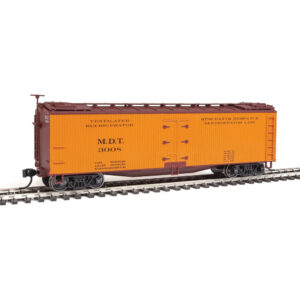
Walthers Mainline HO 40′ Wood Reefer Merchants Despatch
$23.00 Select options This product has multiple variants. The options may be chosen on the product page -

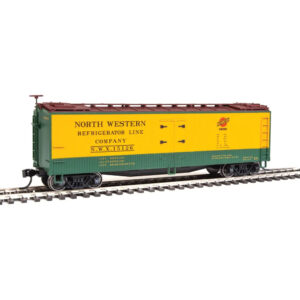
Walthers Mainline HO 40′ Wood Reefer North Western Refrigerator Line
$23.00 Select options This product has multiple variants. The options may be chosen on the product page -
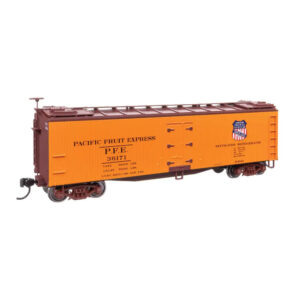
Walthers Mainline HO 40′ Wood Reefer Pacific Fruit Express
$31.00 Select options This product has multiple variants. The options may be chosen on the product page -
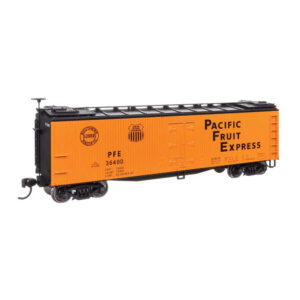
Walthers Mainline HO 40′ Wood Reefer Pacific Fruit Express “Black Roof & Ends”
$31.00 Select options This product has multiple variants. The options may be chosen on the product page -
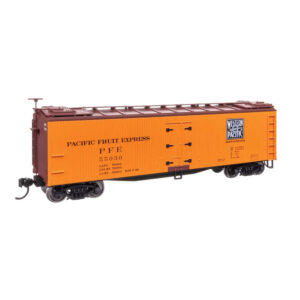
Walthers Mainline HO 40′ Wood Reefer Pacific Fruit Express “WP”
$31.00 Select options This product has multiple variants. The options may be chosen on the product page -
Walthers Mainline HO 40′ Wood Reefer Santa Fe
$23.00 Select options This product has multiple variants. The options may be chosen on the product page -
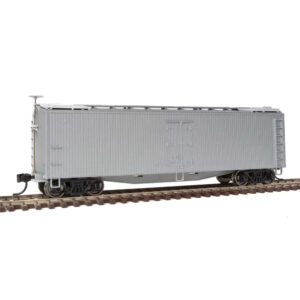
Walthers Mainline HO 40′ Wood Reefer Undecorated
$23.00 Add to cart -
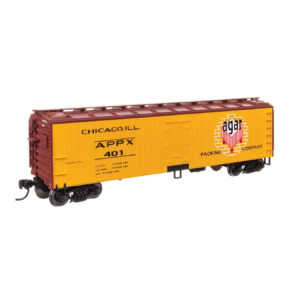
Walthers Mainline HO 40′ Wood Reefer with Steel Ends Agar “APPX”
$29.00 Select options This product has multiple variants. The options may be chosen on the product page -
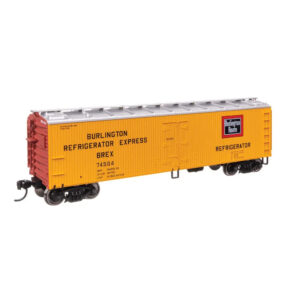
Walthers Mainline HO 40′ Wood Reefer with Steel Ends Chicago Burlington & Quincy “BREX”
$29.00 Select options This product has multiple variants. The options may be chosen on the product page -
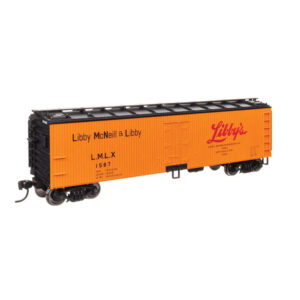
Walthers Mainline HO 40′ Wood Reefer with Steel Ends Libby’s “LMLX”
$29.00 Select options This product has multiple variants. The options may be chosen on the product page -
Walthers Mainline HO 40′ Wood Reefer with Steel Ends Pacific Fruit Express
$29.00 Select options This product has multiple variants. The options may be chosen on the product page